Gingerbread Chickens

013                        “Run, run as fast as you can. You can’t catch me…… I’m the Gingerbread Man!”……………  “Wanna’ bet” said the Gingerbread CHICKENS.010
Ok….it might be a bit of a stretch, but maybe it’s time to change things up a bit and Mr. Gingerbread Man could show some good cheer and share some of the festive spotlight with…..the CHICKEN. After all, what contributions has the Gingerbread Man made to our palates besides…a cookie and the odd cake or loaf? Last time I checked, it wasn’t bacon & gingerbread or gingerbread Benedict or…..well…you get the picture.

So last weekend, Non-Egg Eating Daughter and myself decided to make some Christmas gingerbread cookies. I’m quite aware that the “cookie making window” may be closing for us as I try to compete with One Direction, trips to the mall,  iPads and Tumblr. Maybe she’s just humoring her Old Man, but I’ll take what I can get. We’ve been Christmas baking together for a number of years and I’m glad that she’s doing it once again.

This is an easy cookie recipe and fun to make with kids. Non-Egg Eating Daughter helps with making the dough and then she takes complete control of the “cookie cutting” and decorating roles. I hope you give it a try and maybe make some less traditional gingerbread cookies besides the gingerbread man.

Makes approximately 30 cookies.

Ingredients:

3 1/2 cups all-purpose flour

1/2 tablespoon baking powder

1/2 tablespoon ground ginger

1/2 teaspoon ground nutmeg

1/2 teaspoon ground cloves

1/2 teaspoon ground cinnamon

1/2 teaspoon salt

1/2 cup butter melted & cooled

1/2 cup molasses

1/2 cup brown sugar packed

1/4 cup water

1 egg

1/2 teaspoon vanilla extract

Directions:

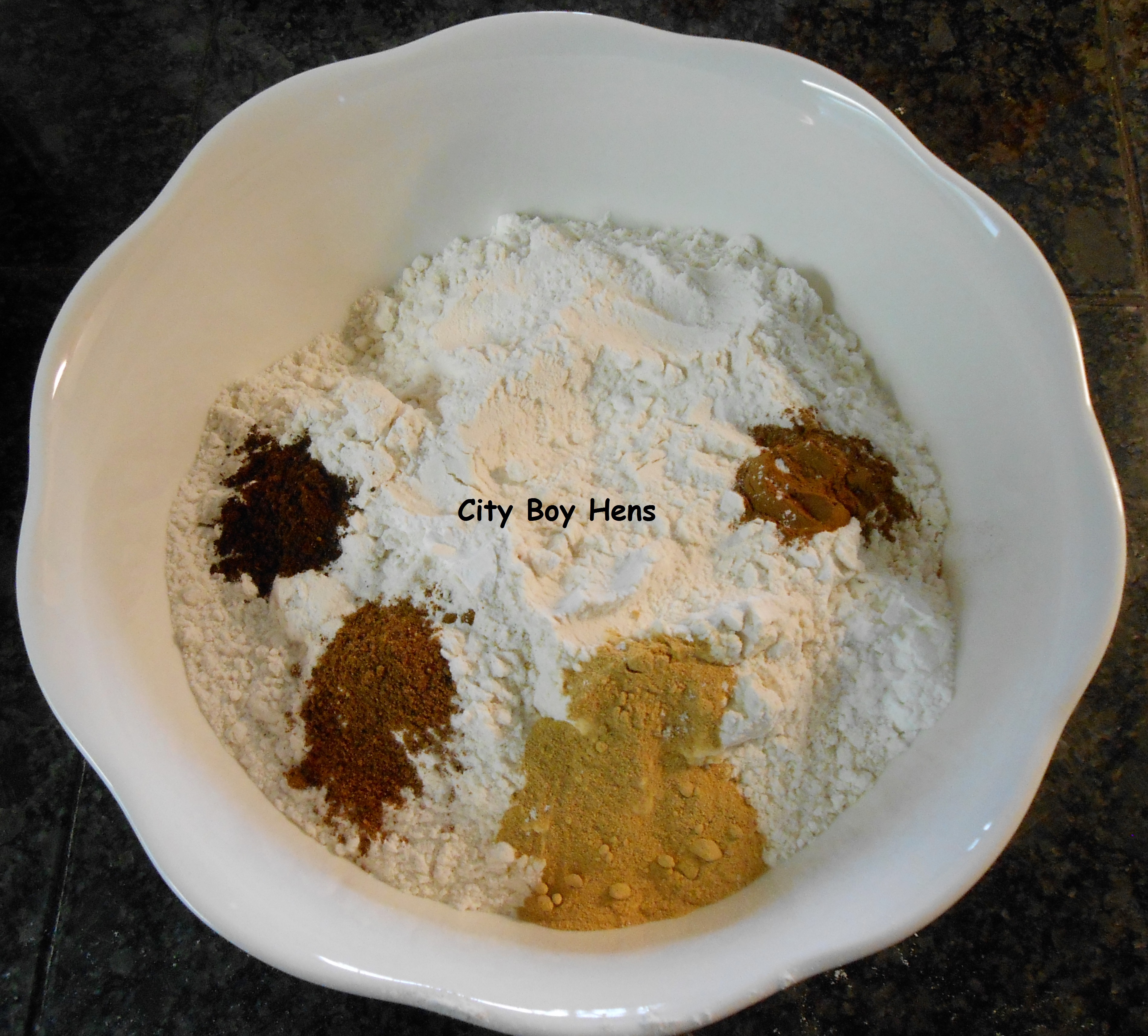
Sift together flour, baking powder, ginger, nutmeg, cloves, cinnamon and salt.  Set aside.027

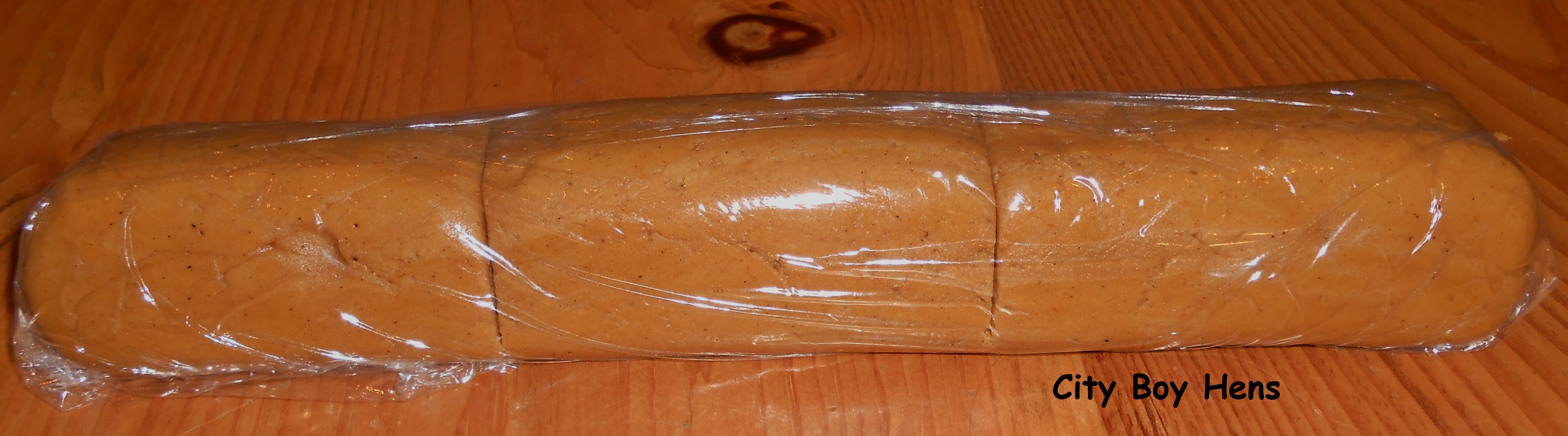
In another bowl, mix together butter, molasses, brown sugar, water, egg and vanilla until smooth. 028             Stir in dry ingredients – one-third at a time until completely combined.  Roll dough into a tight ball, wrap in plastic wrap and refrigerate for 3 hours.  *If time is tight and outside temperature is conducive, divide your dough into thirds and place your bowl of dough outside for a faster chill.002

Preheat oven to 350 degrees Ferinheight.  On a lightly floured  surface, roll a portion of the dough out to 1/4 inch thickness.  Leave the rest in the fridge or outside.  Cut into desired shapes and space cookies 1 inch apart on an ungreased cookie sheet.005

Bake for 10-12 minutes and remove from baking sheet to cool on racks.

Decorate with icing  (1/4 cup confectioners’ sugar with a few drops of water).

“Well…..thanks again Non-Egg Eating Daughter.  It wouldn’t be Christmas for me if we didn’t get the chance to bake together!  Now…go clean up your room  before your Mom freaks out again!”

012

Christmas Biscotti

016 - Copy“OK……….there’s gingerbread men, sugar cookies, snickerdoodles and a host of other Christmas cookies, but where the heck are the biscotti??????????????????????  Well……I’m glad to report that Christmas Biscotti has made its introduction at City Boy Hens.  I came up with the recipe by adapting my original biscotti recipe Click Here and some inspiration from my Christmas Fruit Cake recipe Click Here.  These cookies are easy to make and look very festive.  But, best of all, they are not loaded with sugar and butter which seem to be a common thread in a lot of other Christmas cookies.

*For the purpose of this post, I have made two separate biscotti recipes.  This will allow you to sample 2 different loaves in one try.  If you are partial to one recipe, than double the ingredients in bowl #1 or #2 (see below).

Directions:

Beat 1/3 cup of room temperature butter for 30 seconds.

Combine 2/3 of a cup of sugar, 2 teaspoons of baking powder & 1/2 a teaspoon of salt with the butter.

Beat in 2 farm fresh eggs.007

Stir in 2 cups of all-purpose flour, 1/3 at a time until completely mixed.  Form into a ball and divide in half.009

In two separate bowls combine the “Christmas” ingredients:

Bowl #1

1/2 cup chopped candied cherries   001 - Copy

3/4 cup dried currants

1/2 cup chopped almonds

zest of 1 navel orange

1/2 teaspoon of almond extract

Bowl #2

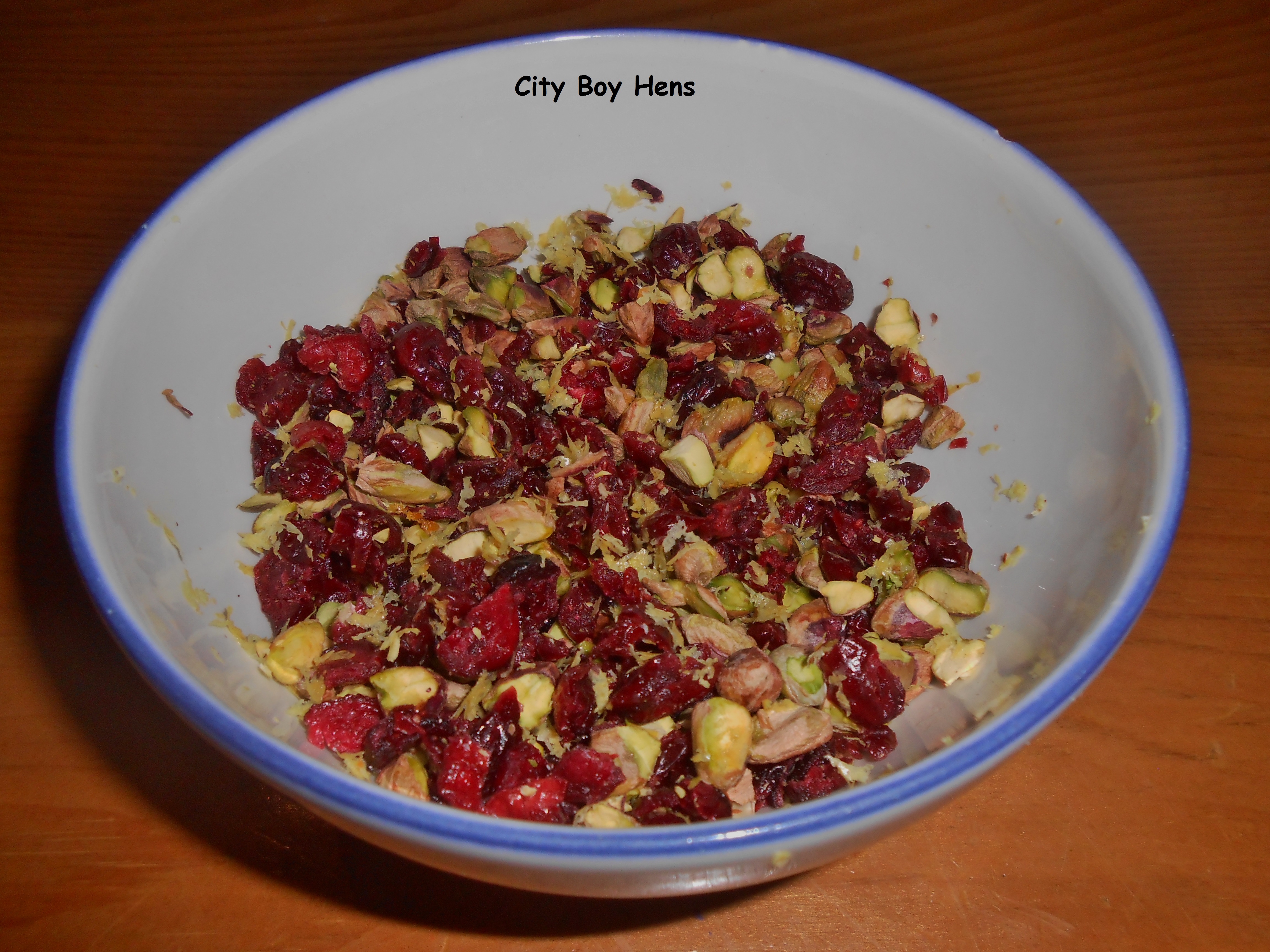
1/2 cup of chopped dried cranberries003 - Copy

1/2 cup of chopped pistachios

zest of 1 lemon

1/2 teaspoon of lemon extract

Remove one half of the dough from your mixing bowl and set aside.  Add the “Christmas” ingredients from bowl #1 to your dough.  Need until all ingredients are completely combined and evenly distributed in the dough.  Remove the dough from the bowl and place on a lightly floured surface.  Using the palms of your hands, press and shape the dough until it is around 10 ” long and 5″ wide.  Gently lift  up the dough and place it on one side of a cookie sheet.

Repeat this process for bowl #2.011 - CopyBake at 375 Ferinheight for 20-25 minutes or until loaves are golden brown.  Remove from oven and cool on rack.012 Using a serrated knife, cut the biscotti into 3/4″ strips and transfer back on to a cookie sheet and bake at 325 F for another 8 minutes/ side.015 - CopySo….there you have it……..Christmas Biscotti.  Move over gingerbread men and sugar cookies.  There’s a new cookie moving into the festive spotlight.  I hope you give it a try! Buon Natale!016 - Copy

Making Christmas Fruit Cake With A Traditional Twist

004Christmas cake, fruit cake, holiday cake…..whatever you want to call it…….this cake has had a love/hate relationship with a lot of folks.  Quite simply, you are either a huge fan of this Christmas tradition or you look upon it with the same revulsion as The Plague! If you fall in to the second category than I’ll bid you a good day and hope you’ll drop by again.  But, if you enjoy the combined taste of almonds, currants, dates, raisins, candied cherries and citrus all baked up into a flavorful greatness, than I’ll bet that you love fruit cake and look forward to buying this cake at Christmas.  But this year, instead of buying Fruit Cake, why not try your hand at making this Holiday favorite?  I promise……it really isn’t hard!

My initial desire to make this cake came from two separate areas.  First, my Dad LOVES fruit cake.  I can still remember his “company gift” fruit cake coming into our house on Christmas Eve and being strategically placed on top of our fridge.  Every January evening after dinner, that fruit cake was taken down from its sacred spots and a small piece was sliced off and washed down with a cup of coffee. So for you Dad, I’m really making this cake, though I too am a fan of the fruit cake as well.  Secondly, my blog is focused on “stepping back to a simpler time” and I received a great opportunity this month to make a fruit cake in a wood fired brick oven just the way folks would have done so more than 150 years ago!  So…. without further adieu, here is a classic fruit cake recipe that I hope you will enjoy.  Oh….by the way, ……you don’t need the wood fired brick oven.  Your conventional oven will work just fine.

Makes 1 large cake or 3 small cakes

Ingredients:

1/2 cup slivered blanched almonds

1 cup candied cherries cut in half

1/2 cup chopped mixed peel

1 cup raisins

1/2 cup dried currants

1/2 cup chopped dates

1/4 cup brandy

* combine and allow to stand overnight014

Grease a loaf pan which will hold 5 1/2 cups of ingredients or 3 small pans which will each hold just under 2 cups of ingredients. 

Blend together:

1 1/2 cups all-purpose flour

1/4 teaspoon baking soda

1/2 teaspoon cloves

1/2 teaspoon allspice

1/2 teaspoon cinnamon

1/4 teaspoon salt042

Cream

1/2 cup butter

Gradually blend in

1 cup lightly packed brown sugar

3 eggs044

Mix together

3/8 cup molasses (1/4 cup + 2 tablespoons)

3/8 cup apple juice/ cider (1/4 cup + 2 tablespoons)

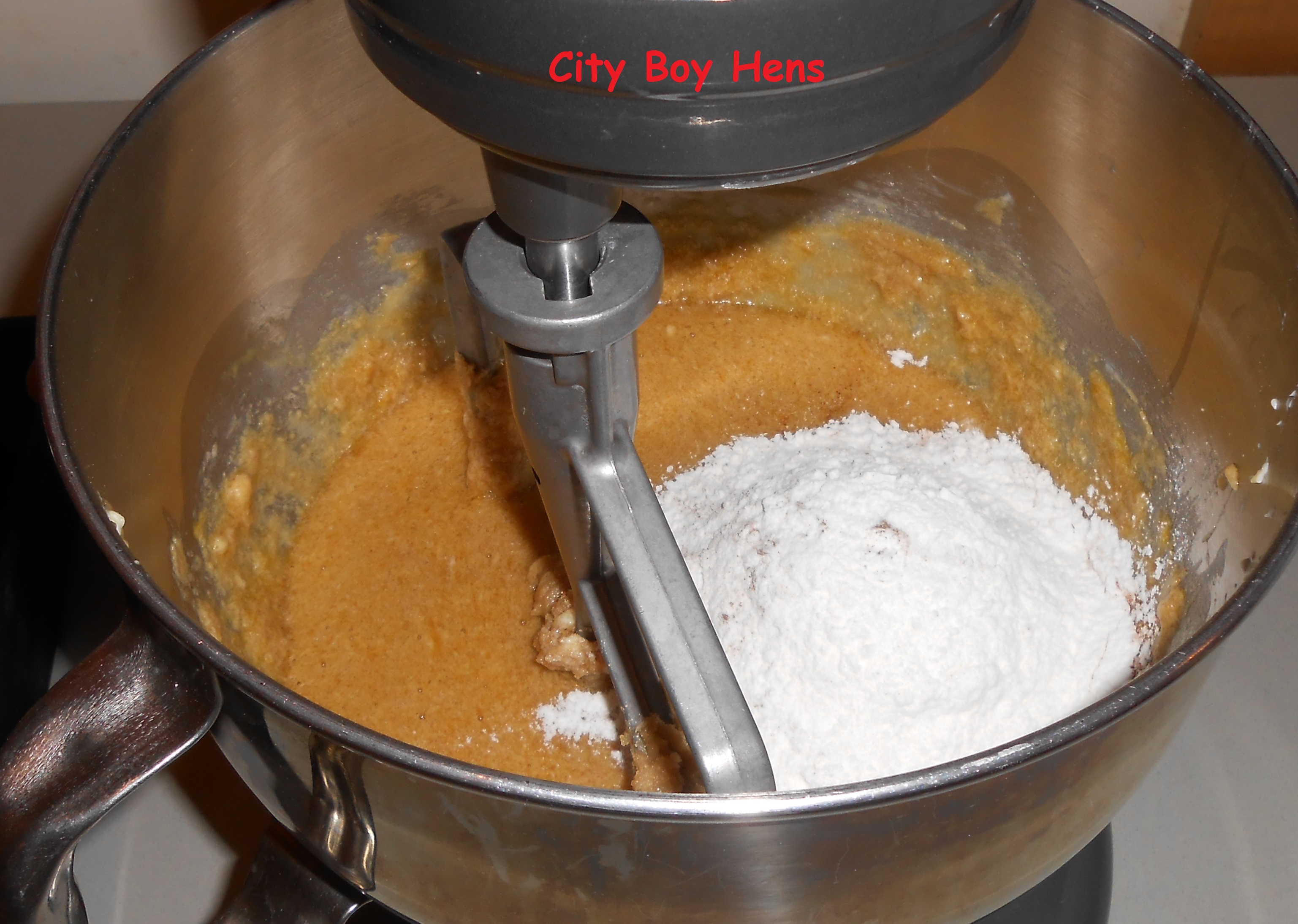
Add sifted dry ingredients alternately with liquid.  Make 4 dry and 3 liquid additions.  Fold in flavored fruit.  Turn into a prepared pan.046049

051

054 - Copy

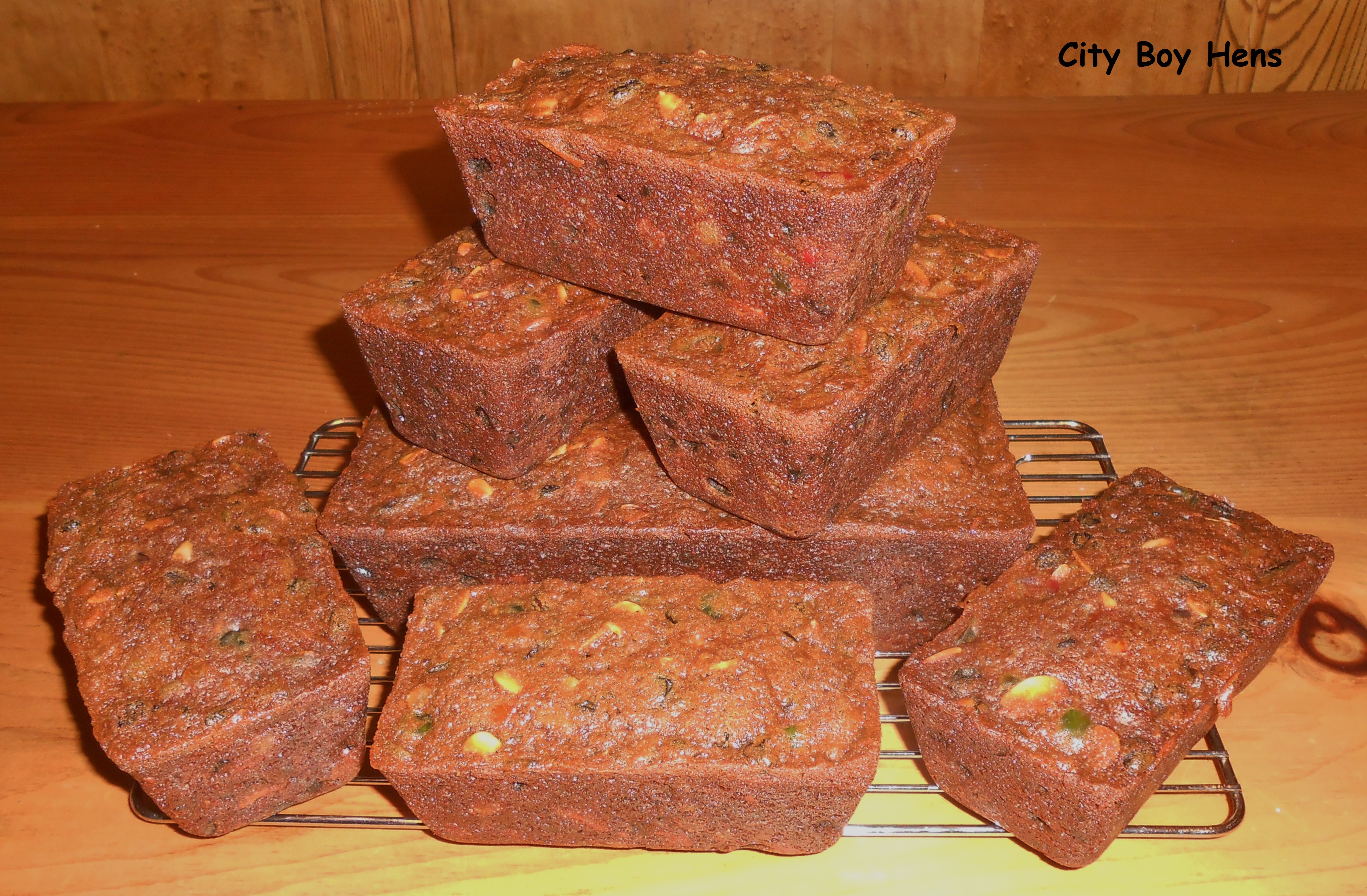
Bake in 275 degree oven for 3 to 3 1/2 hours for a full size cake and 2 hours & 40 minutes for a mini cake.  Because every oven is different, make sure to test your cake by inserting a toothpick into the cake,  If the toothpick comes out “clean” you will be good.  Remove from pan and lift off parchment paper.  Drizzle generously with brandy (around 2 tablespoons).065 - Copy


021

Cool cake completely and then wrap loosely in wax paper and store in an air-tight container.060

Getting Your Backyard Chickens Ready For Winter

After a Snow Fall

Winter is knocking at the door up here in Southern Ontario.  The leaves on the trees have pretty much disappeared, daylight hours continue to decrease and the night-time temperatures are toying with freezing.  With that said, this City Boy needs to make a few changes to our coop/run in order to keep “the ladies” healthy and productive through the long cold months ahead.

1)  Minimize Drafts063

My 3 hens have a 60 square foot run that is enclosed with hardware cloth.  This makes for a great predator-proof and airy environment in the warmer months, but too much wind does not bode well for chickens in the colder months.  Like you and me, they also really start to feel the cold when that Northern wind starts blowing.  Even with that thick  coat of down feathers, too much energy will be used to keep warm in winter when those prevailing Northern winds continue to blow.  In order to remedy this problem, most of my run is covered with plexiglass in the winter.  I emphasize most, because you still want some fresh air to circulate throughout the run in winter.  You just don’t want the strong cold winds to accompany them.

The upside to plexiglass is that it is transparent.  In other words, I can still keep an eye on the chickens in the comfort of my warm home as I write this post.  The down side is that it is expensive.  If this is an issue, then consider using plastic vapor barrier as an alternative.  The down side is that it is not really transparent, but it is relatively inexpensive.  Just make sure not to seal everything up too tight and prevent air from circulating within the run.  I recommend securing the vapor barrier on the outside of the hardware cloth with some 1×2 strapping.

2) Heat & Light In The Coop092
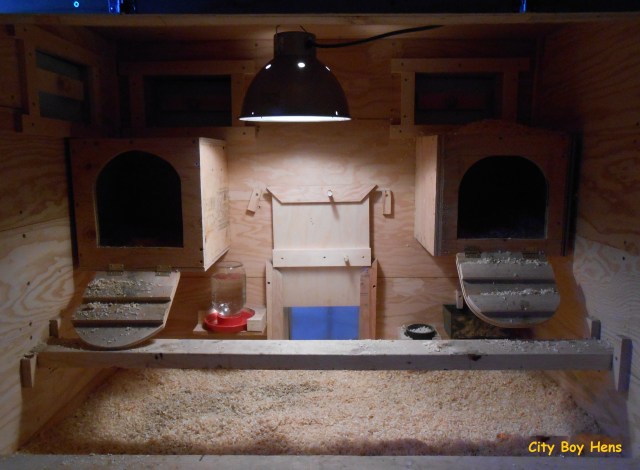
I heat and light my coop with a 100 watt incandescent bulb that is screwed into a secured brooder lamp (note: the safety screen on the lamp was temporarily removed in order to show the entire coop in the above photo).  I didn’t go to the effort of running electricity out to the shed in order to keep the hens warm.  I did it so that the drinker and eggs would keep from freezing.  The cost sure outweighs schlepping water out to the coop a few times a day because the drinker has frozen again.  I am also a believer in getting eggs all year-long so I do provide my hens with additional “artificial” light in order to stimulate their pituitary gland and keep those eggs coming every day.  I also went to the trouble of completely insulating the coop with 2 inch Styrofoam when I built it a few years back.  Between the insulation and the light bulb, I have never had an egg or the drinker freeze in the last two years. * Note:If you choose to light your coop, make sure to wipe the cooled bulb from time to time and NEVER use a “coated (shatter-resistant) bulb”.  I read that the chemical that is used to coat these bulbs gives off a toxic gas that can become lethal to chickens who are confined in a small area.

3)  Make a Dust Bath
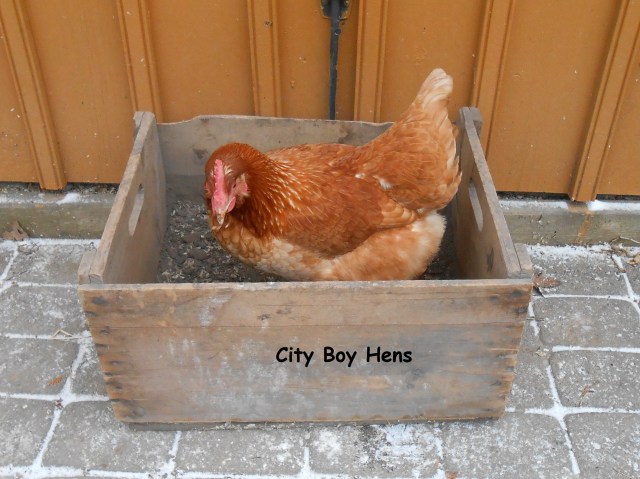
Honda demonstrating for you!

If you let your chickens free range, I’m sure you are aware of their need to tear up your favorite garden and enjoy a dust bath.  You can’t blame them.  It’s ingrained in their DNA and they perform this incredibly euphoric act to not only clean themselves, but also rid themselves from the potential for lice and mites.  Don’t know about you, but free ranging is severely curtailed in the winter at City Boy Hens and the ground becomes hard as a rock. So..in order to satisfy their need,  I made the chickens a dust bath for their run.  They use it daily and wait patiently to take their turn!  If you would like a few ideas on making a dust bath, CLICK HERE.

4)  Keep Them Busy.
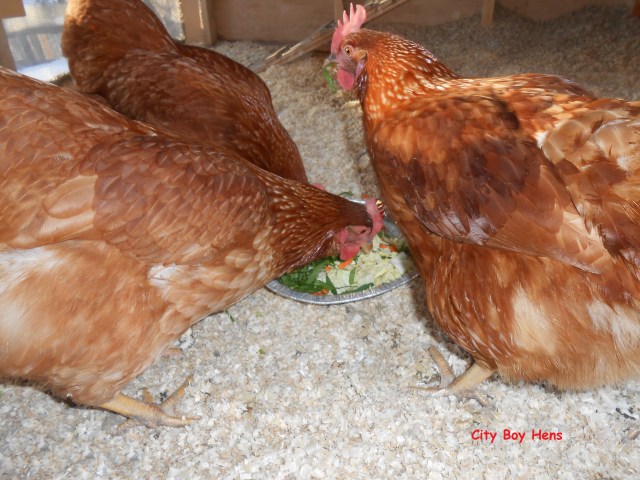
Snackin'

Snackin’

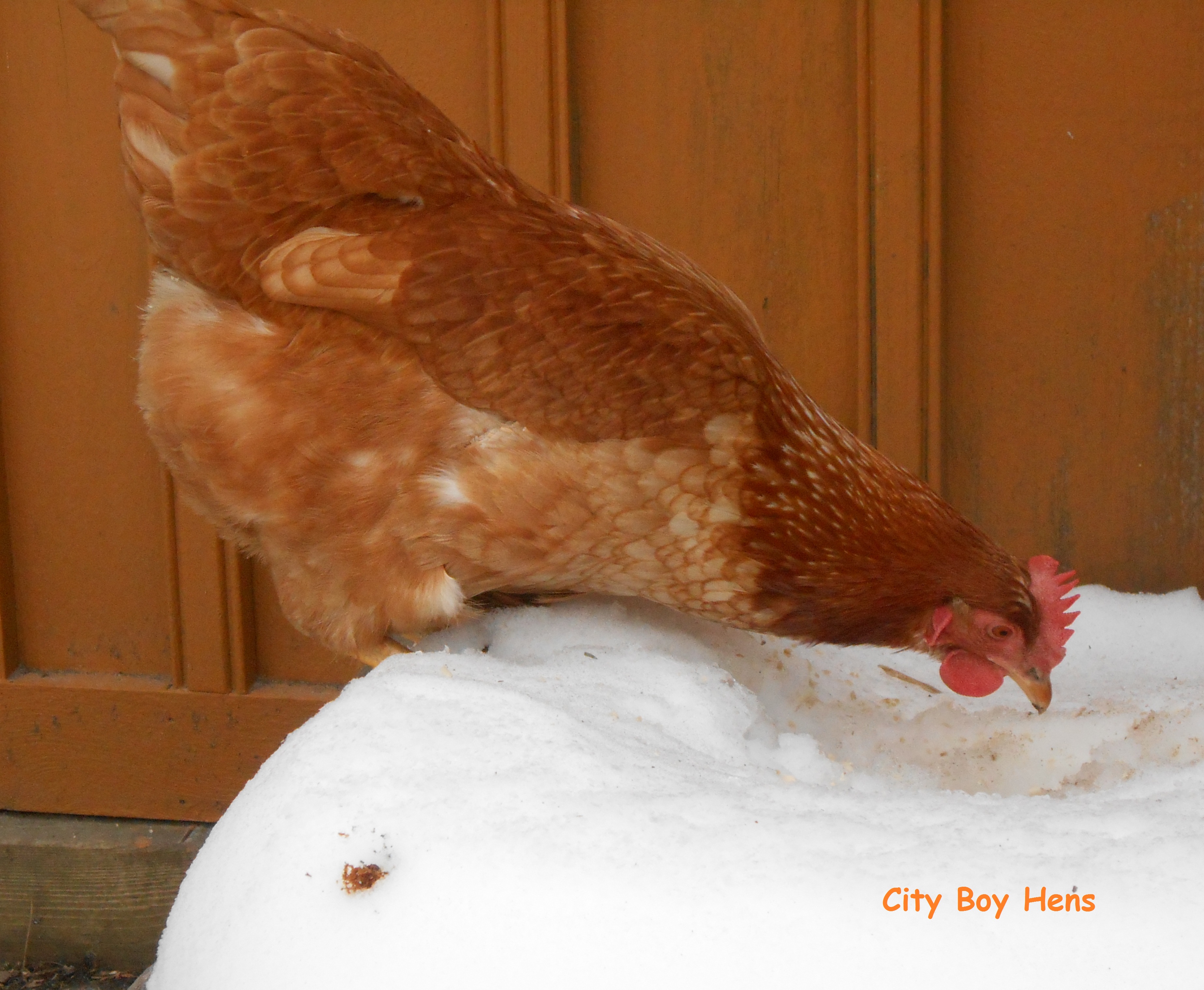
Chickens are always on the move looking for the next blade of grass or bug.  It’s pretty hard to find either when snow is covering the ground.  Unfortunately, idle time can sometimes lead to bullying and this can open a whole new can of worms.  So why not give your hens some extra treats in the winter in order to keep them occupied?  Every morning, I scatter a handful of scratch onto the floor of the run.  The scratch gets “lost” in the wood shavings and the chickens spend lots of time “scratching” for it.  This serves a few purposes.  First, the scratch metabolizes fast and gives them a quick energy boost for heat.  Second, it helps “satisfy” their need to forage.  Lastly, it helps keep their toe nails trimmed which will prevent overgrown  nails and potentially distorted feet in the future.  But remember, scratch should only be used as a treat.  It does not have the same nutritional requirements as regular layer feed.

I also supplement their layer feed with chopped up spinach, carrot peelings and tomatoes.  This is a great “nutritional” treat that will help to keep your chickens healthy in those non-free ranging months. I’ve also strung a cabbage up in the run from time to time and the chickens love to peck at it for hours.  Just remember, these foods should be given as “treats” with the primary food still being layer feed.

5)  Humidity

Animals in confined quarters that poop with the frequency of chickens can sure raise the humidity level in a coop.  Unfortunately, this can lead to frost bite on combs and wattles if the temperature is too low and the humidity is too high.  As stated earlier, it is essential that fresh air is circulated in the coop.  You don’t need a lot, just a bit of movement that replaces the stale moist air with fresh “drier” air.

Humidity can also be decreased by regularly cleaning up of poop in the coop.  Some folks use a drop board under the roost and that works great.  I just pick it up with a cat litter scooper every morning before heading off to work.

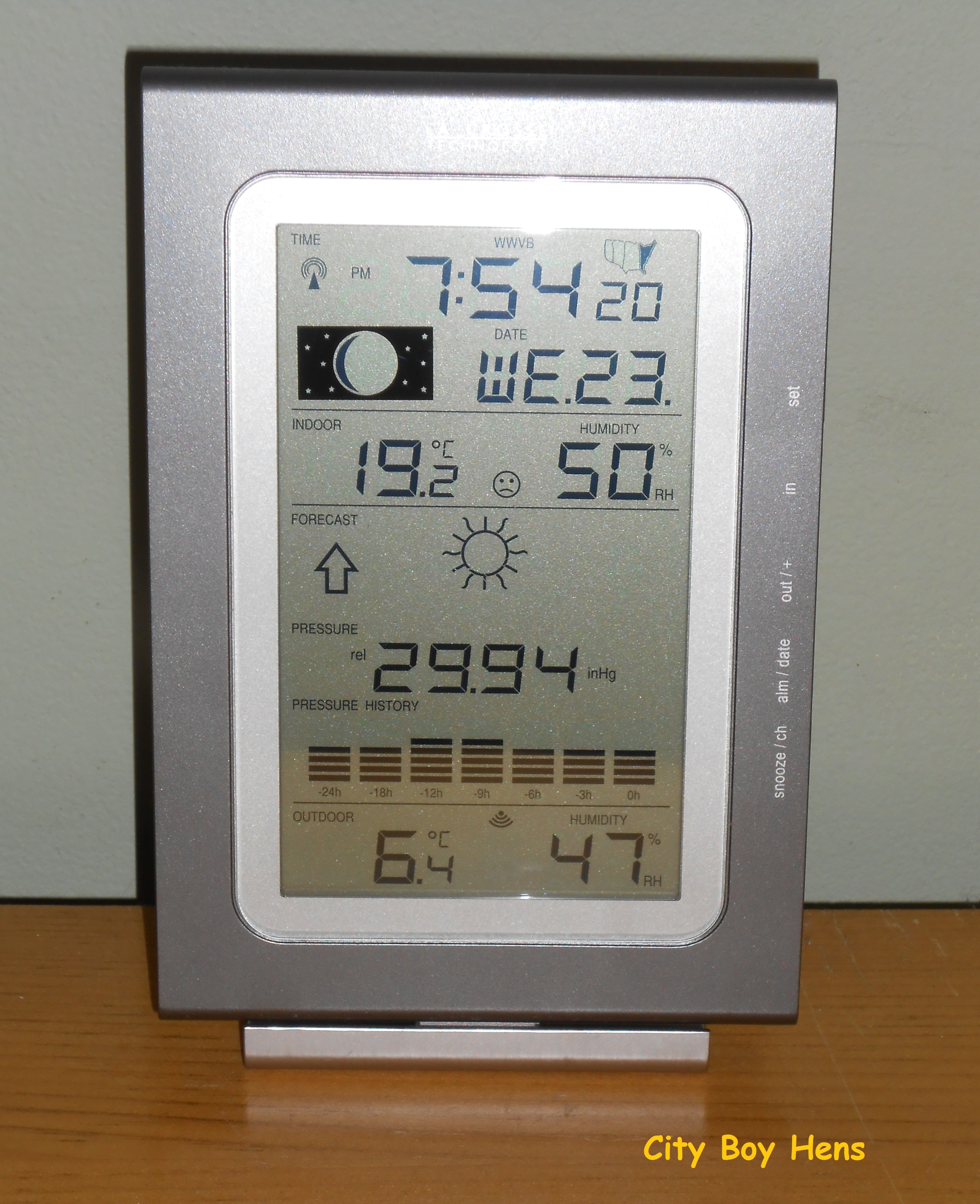
But if you really want to keep track of the humidity level in your coop, you could purchase a portable weather station and keep a sensor in the coop.  This will, not only let you read the relative humidity, but also inform you of the temperature in the coop.  I’m not embarrassed to say that I have checked the read out a few times on those nights when the temperature dipped down well below freezing!
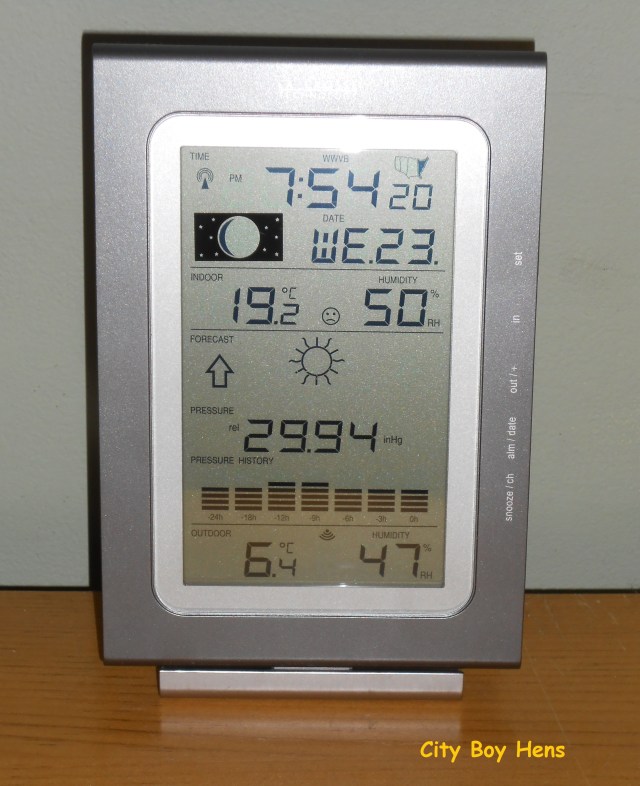
-10C outside and 6.4C inside the coop at 7:54pm.  Nighty night girls!

-10C outside and 6.4C inside the coop at 7:54pm.

So….there you have it………..my 5 recommendations for healthy & productive hens throughout this coming winter.  I’m going into my second winter at City Boy Hens and I’m glad that my experiences from last year have taken a lot of the surprise out of Old Man Winter’s bag of tricks. I’m no expert, but I’ve learnt a lot from the Winter of 2012.  “So……… bring it on Old Man Winter!  We’re Ready!  Oh…and ladies….don’t you be worrying.  Just keep pumpin’ out those eggs……I ‘ve got you covered!”

*If you would like would like more information on my coop/run CLICK HERE.  Feel free to drop me a line if you have any further questions!  I will do my best to get back to you in a timely and knowledgeable manner.

Tucked and Hidden Away

Thanksgiving Harvest Apple Cake

024We like to eat a lot of apples at City Boy Hens.  So much so, that I buy them by the bushel.  On their own, apples make a great snack, but combined in a cake….they are excellent.  This cake is very easy to make and is a family favorite.  It originates from memories of my childhood when it was baked by my Mom on Sunday afternoons in Winter. I guess I’ve managed to “pass the torch” because my kids love this cake as well and it always makes its first appearance of the year on Thanksgiving weekend.  Up here in Canada, we already celebrated Thanksgiving back in early October and now I have the opportunity to share this recipe with my neighbors who are “south of the border”.  I hope you give it a try.

Ingredients

Filling

1/4 cup melted butter

3/4 cup brown sugar

2 apples – peeled and thinly sliced

Batter

1 3/4 cups all-purpose flour

3  tsp. baking powder

3/4 tsp. salt

1/2 tsp. cinnamon

1/3 cup butter at room temperature

1 cup sugar

2 eggs

1 cup milk

1 tsp. vanilla extract

Directions

Filling

Preheat oven to 350 F.

Pour melted butter into a 10-inch cake pan.  Make sure to cover the edges of the pan.

Sprinkle sugar on top.

Add sliced apples and set aside.011 - Copy

Batter

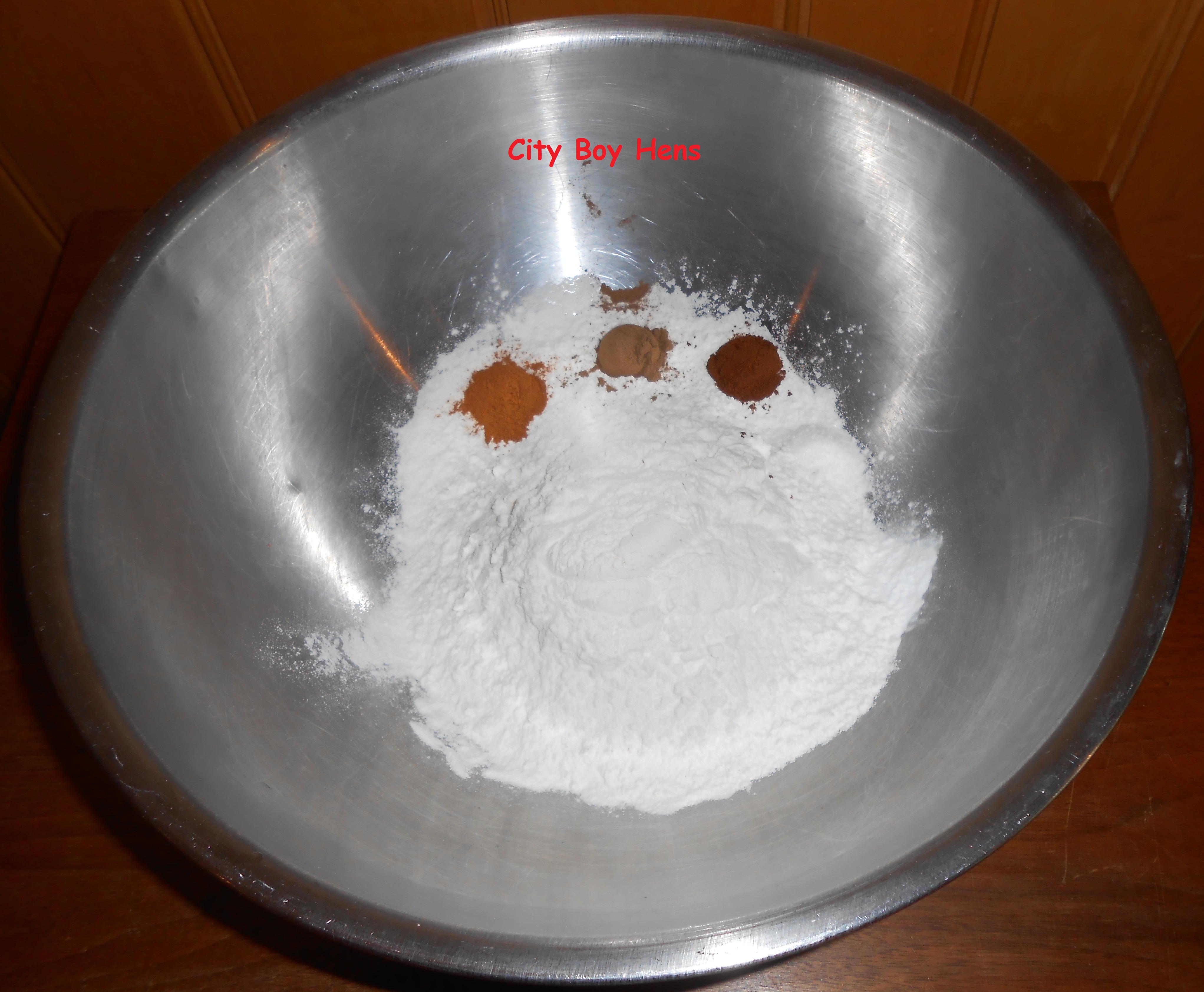
Sift together flour, baking powder, salt and cinnamon.016

Cream together butter and sugar in a separate bowl.  Beat in both eggs.012

Combine milk and vanilla extract in a measuring cup.

Alternate adding 1/3 of the dry ingredients and 1/3 of the milk to the creamed butter.  Beat in between additions.

Once the final “thirds” have been added, beat the batter for 1 more minute.

013Spread batter over apples in cake pan.017

Bake for 45-50 minutes until golden brown.

Cake is done when a toothpick is inserted into the center of the cake and comes out clean.

Leave cake in pan and cool on rack for 30 minutes. 019

Now, decorate your cake with some leaves from your favorite tree.  I used 4 Japanese Maple leaves that I managed to keep before they all blew off the tree.  Contrary to dutiful son’s misunderstanding, they are not marijuana leaves.021Sprinkle generously with icing sugar and remove the leaves.024To all of my American family and friends, I wish you a great Thanksgiving weekend!

Want To Learn How To Make Italian Sausage?

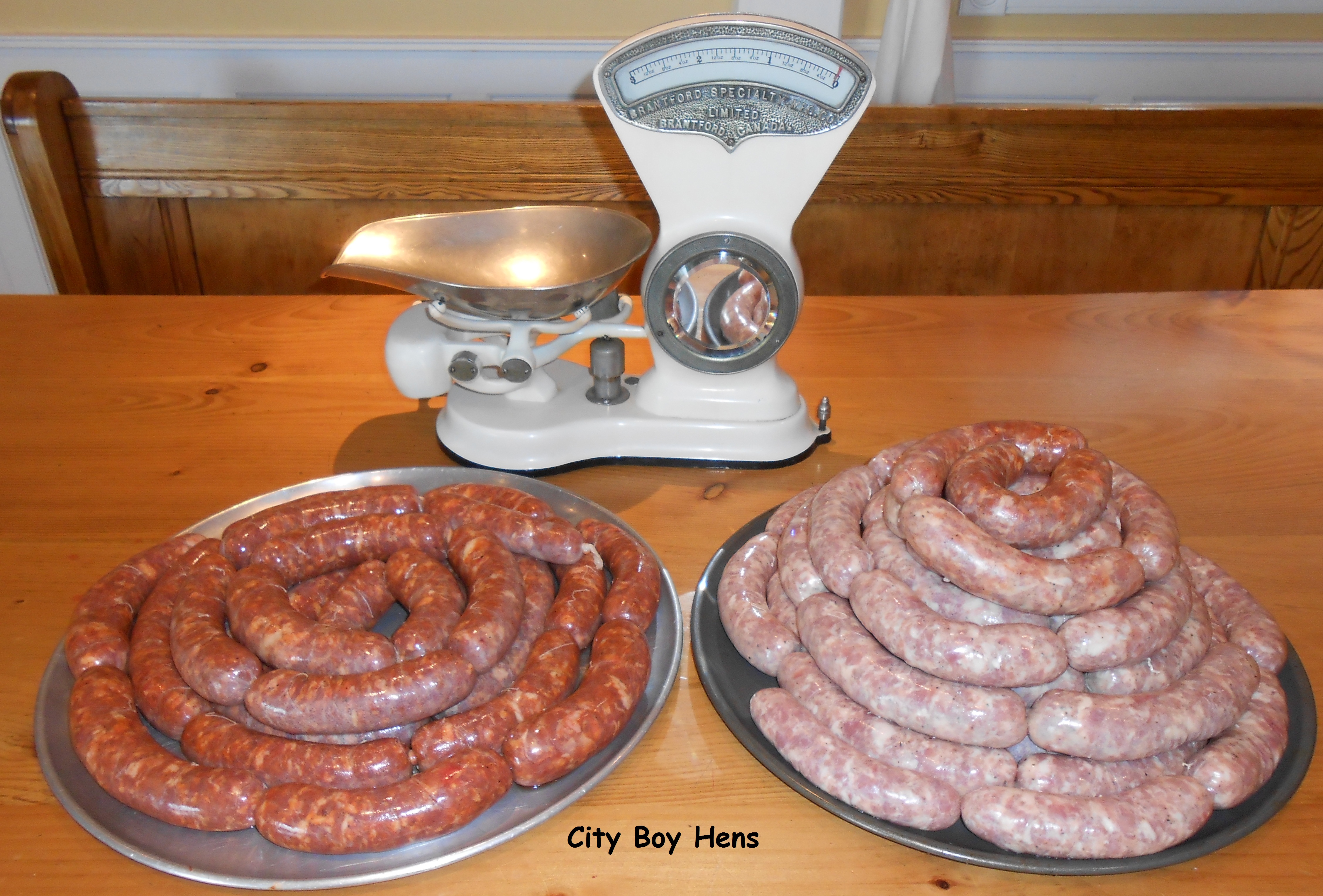
Hot & Sweet sausage.

Hot & Sweet sausage.

Italian sausage season started last weekend at City Boy Hens.  For the last 3 years, my good friend Mike and myself have been making these meaty treats and they taste GREAT!   Whether they are cooked on the BBQ, added to Beloved Wife’s pasta sauce or poached in my chicken and sausage cacciatore they ALWAYS add up to a home run!  But, best of all, they are made with quality ingredients and work out to about half of the price of a store-bought sausage.  For this CITY BOY ,that was enough reason to learn how to make these babies and to chronicle the steps for you to follow.  If I can make it, you can make it as well.  So…..why not give it a try and learn how to make Italian sausage?  Before you know it, you too will be beaming with pride as your family and friends sit down together and share a great meal made with your homemade Italian sausage.  Now…..you’re  just one click away from taking that tasty plunge.  Ready??????  CLICK HERE!
004

Driving Miss Swifer: That Damn Hen Is Makin’ Trouble AGAIN!

Fall is in full swing in Northern Ontario.  It’s a great time for the family to head up to the cottage for a relaxing weekend and enjoy the colors of the changing leaves, cool crisp nights by the wood stove and some hearty comfort foods.  So off we went, beloved wife, dutiful son, non-egg eating daughter, protector dog and……..of course,…….the chickens.  If you are new to following City boy Hens, you may not be aware that we take the chickens to the cottage.  There’s no better way to get the freshest of eggs for a Sunday morning brunch!  Besides…….they too, according to my daughter,  have become part of our family!009 - Copy

For the most part, the hens are no trouble to take to the cottage.  They travel well in their homemade crate and generally rest during the 3 hour trip……….that is until…………….last weekend.039

027

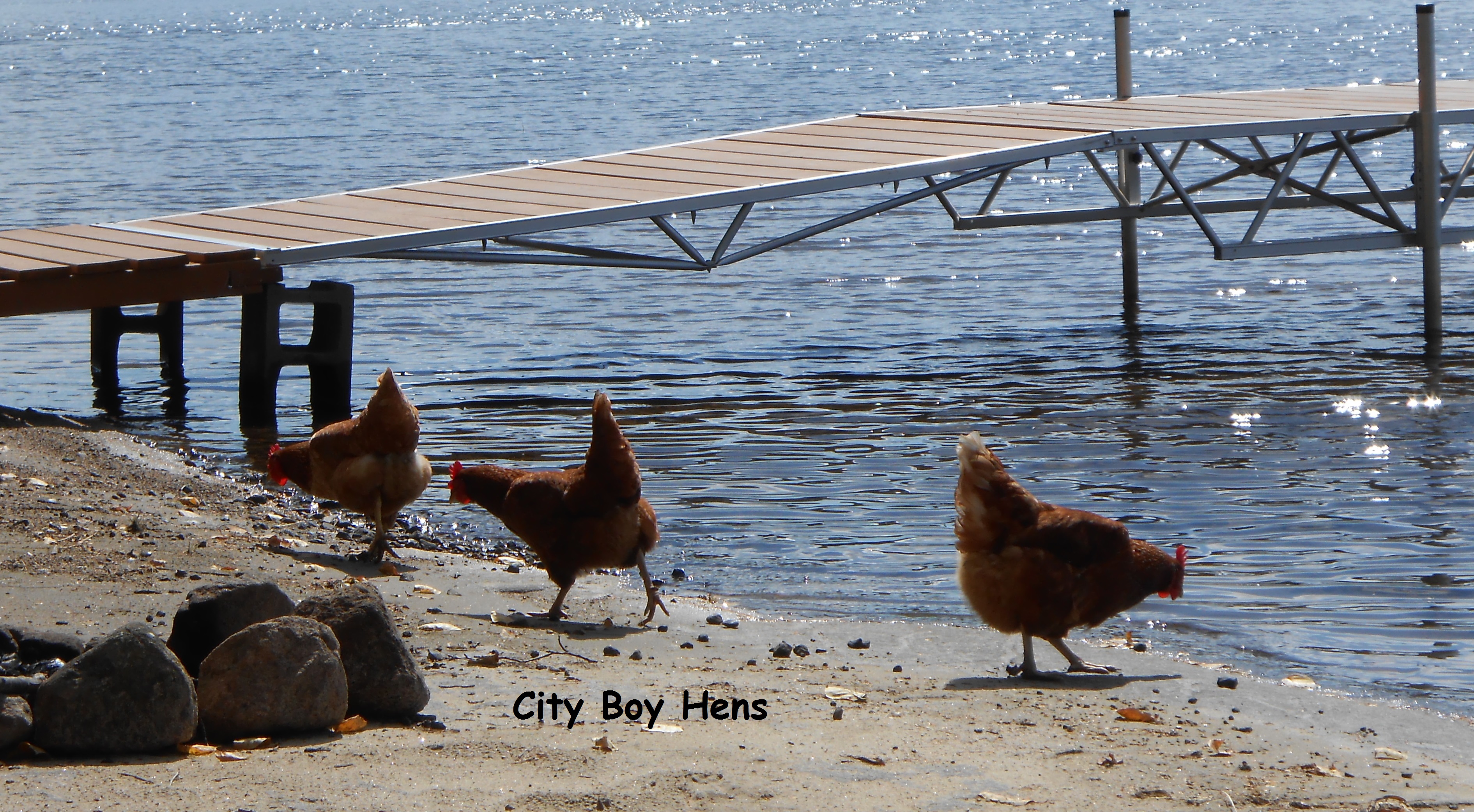
That weekend started out like every other weekend at the cottage.  The trip up North was uneventful and the hens spent their weekend roaming around the cottage property or down by the beach.

Running Down To The Beach.

Heading Down To The Beach.

008 - Copy

010When it was time to pack up on Sunday, I found Swiffer my herself behind the chicken ark in the run.  Generally, the 3 hens are inseparable, but I didn’t  give this too much thought as I picked her up and put her in the crate with Honda and Rosie.  After “buckling” them in, we headed South for the return trip home.

The drive was going along smoothly as beloved wife and myself shared some casual conversation until I heard a piercing scream from endearing daughter!

“Oh my God………..Swiffer laid an egg!……….AAAAAAHHHHHHHHHHH…………It’s splattred everywhere.    Holy $#!*…..Some of it got on my leg……….Oh my God……..they’re eating it!   Oh….this is sooooooo gross!”  Mom………I’m gonna’ puke!!!!!!!!  Dad…pull over RIGHT NOW!!!!!!!!!!!…….

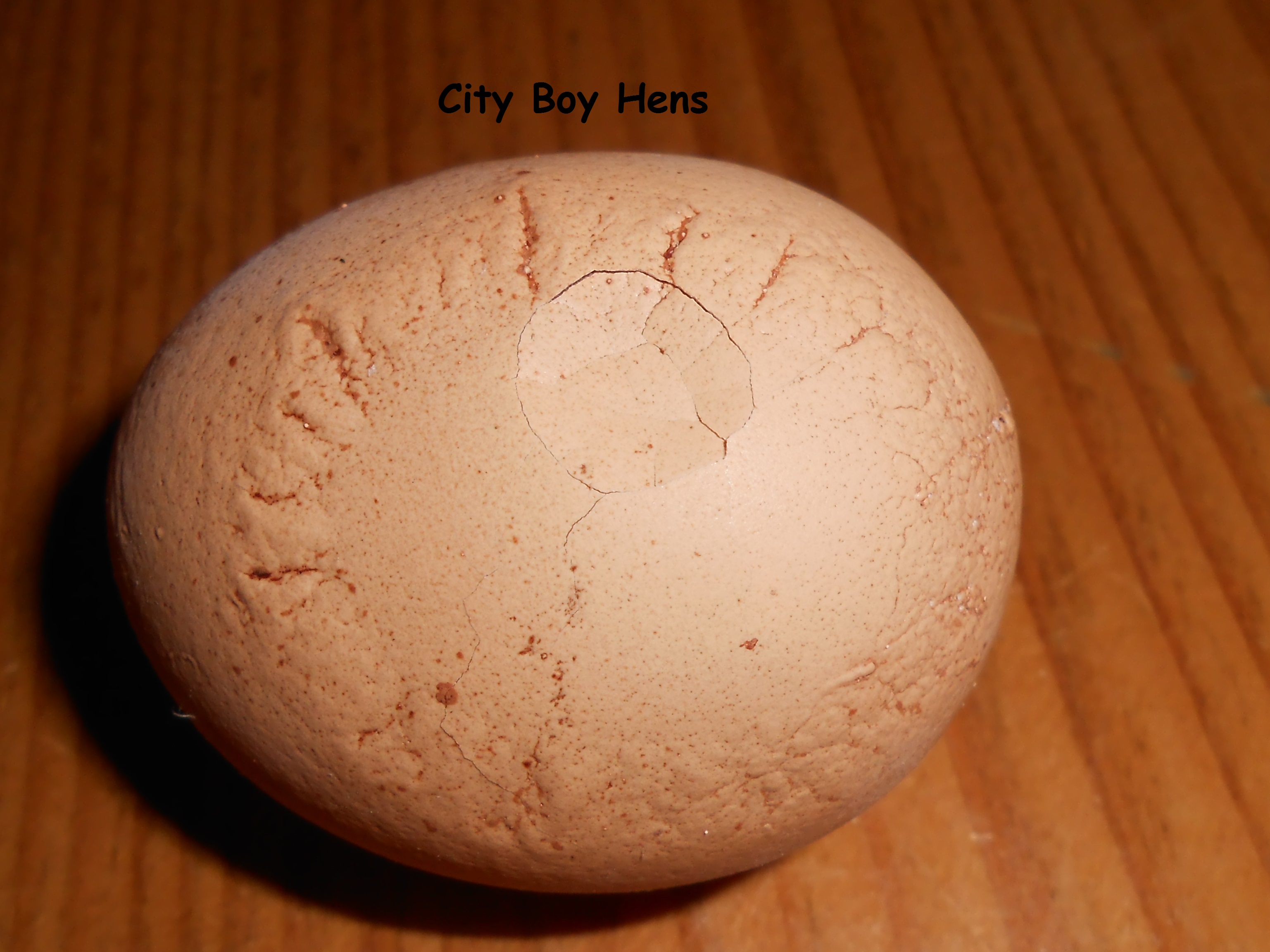
  It turns out that Swiffer had, once again, managed to create pandemonium by just…… being Swiffer!  I guess it’s really not her fault.  It looks like she too is going to be following Honda’s lead and begin molting shortly.  As I learnt a few weeks ago, soft-shelled and crinkled eggs are generally a good sign that a hen will begin molting.

“Alright Swiffer, I just gotta’ know……….why’d you have to lay that “softie” in the van?  Couldn’t you have laid it in the coop like you do every morning?…………. Come on Swiffer…..ANSWER ME!……………Ok……don’t want to talk???????………..Hey Swiffer…….., look over to your right.  See that truck beside us?  Take a look at what’s in the back!  Yes, you are right…those are chickens, but they aren’t coming back home from the cottage like you.  They’re goin’ to visit the bad man called The Butcher!”111

On second thought, maybe I was a bit too hard on poor Miss Swiffer.   Maybe I scared her a bit too much because this soft-shelled, crinkled Ping-Pong ball was what she left me  the following morning.  “Ok Swiffer……I was just jokin’.  There really isn’t a bad man called The Butcher!………..Well…….there really isn’t one………… at least RIGHT NOW!!!!!!!!!!!!!”002

Curing Olives May Be EASIER Than You Think!

Oh……the olive. You either love them or  look upon them like the plague.  If you are in the second group, I suspect that I’ve lost you already.  But, if you are a lover of the olive, I’d like to show you had to easily pickle this tasty treat.  It’s going to take around 3 weeks to cure these babies with about 15 minutes worth of work to do every other day.  After that, you’ll be enjoying some great tasting olives for the next 12 months.

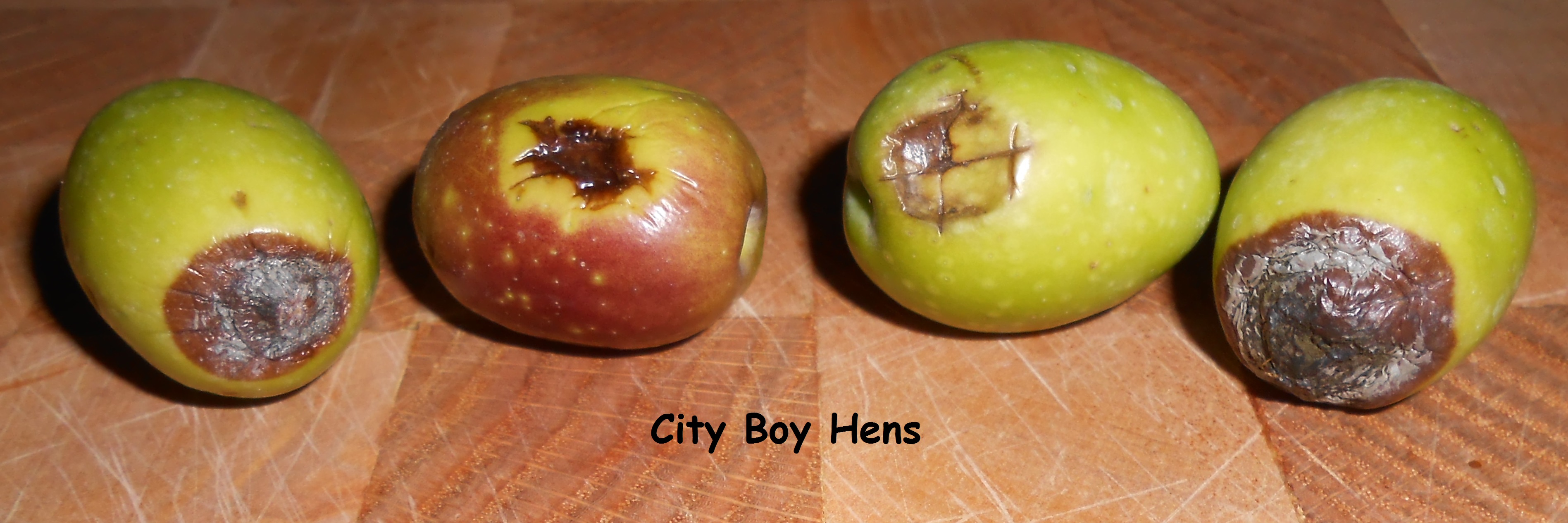
First, go out and purchase a case of green olives.  These olives generally come from California and are available from late September until mid November.  The olives are green in color because they are not ripe (a black olive is a ripened olive).  As a result, they are extremely bitter.  Taste one if you do not believe me.  I’ll bet you a dozen City Boy eggs that you won’t eat 2!002

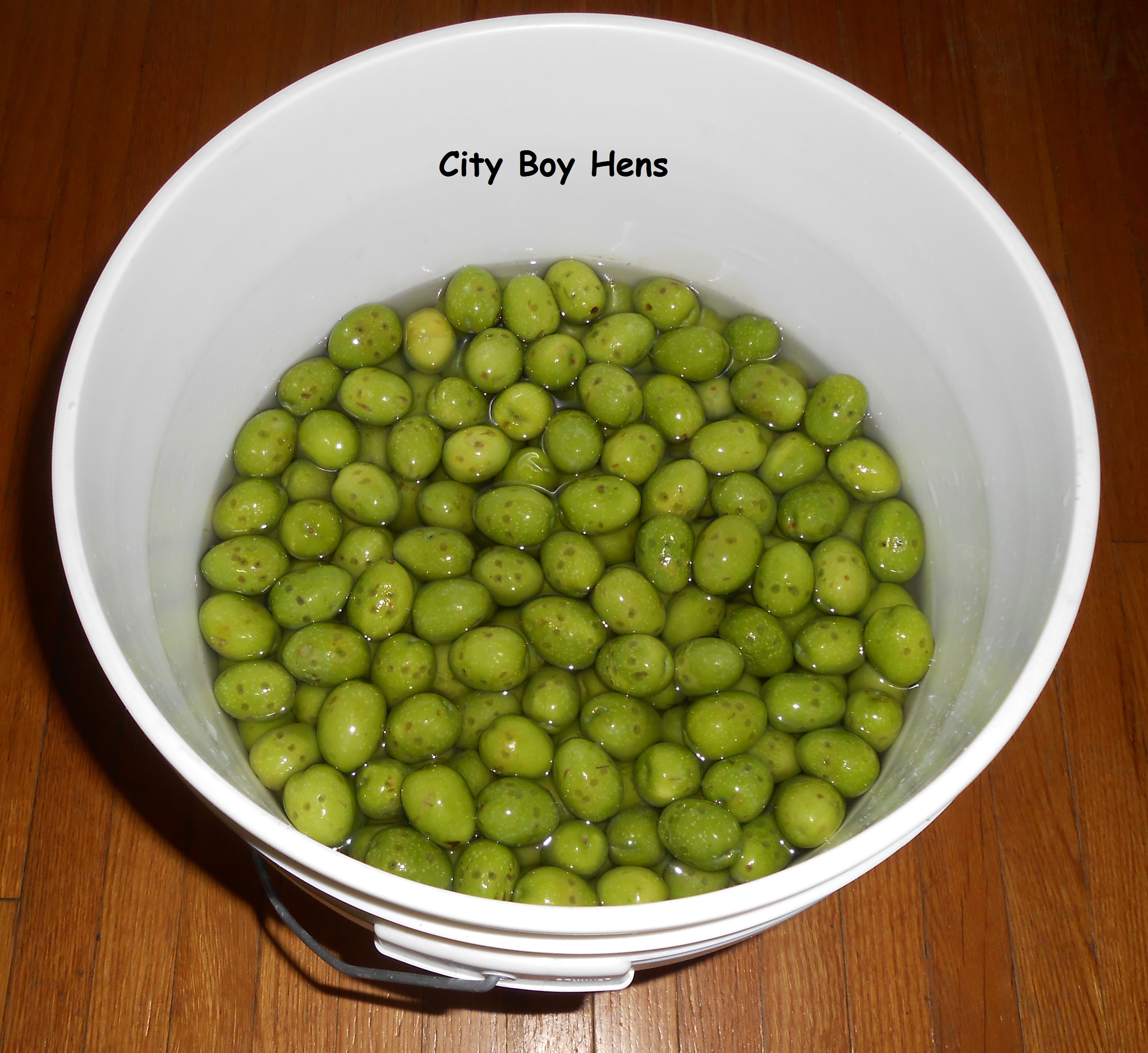
Next, wash the olives in cold water and discard any that are damaged or spoiled012In order to make the olives palatable, the bitter element ( oleuropin), must be removed.  This is done by fermenting the olives in a brine for around 18 days.  This may not seem like a long time, considering that the olive is so bitter, but you are going to speed up this process by piercing the olive several times with a fork.  I do this by holding the olive between my thumb and index finger and piercing it with each turn (3 times will do).  Some folks like to cut slits in the olive with a knife, but I find that this takes too long.  Others like to hit the olive with a hammer, but I do not like the final presentation of smashed olives in a jar.  Either way, it’s entirely up to you.  Just make sure to create “openings” in the olive in order to let the bitterness out. This is the only labor intensive step to making olives and it will take you about 1.5 hours to prick, slit or smash every one.006

007

After pricking each olive, make sure to immediately drop them into a 5 gallon “food-grade”pail that has a brine solution of 1 cup pickling salt and 20 cups of water.  Make sure that all of the olives are immersed in the brine solution.  I have found that the best way to keep the olives immersed is to invert a 10″ dinner plate on top of the olives and weigh it down with a 1 quart mason jar that is filled with water.019

010

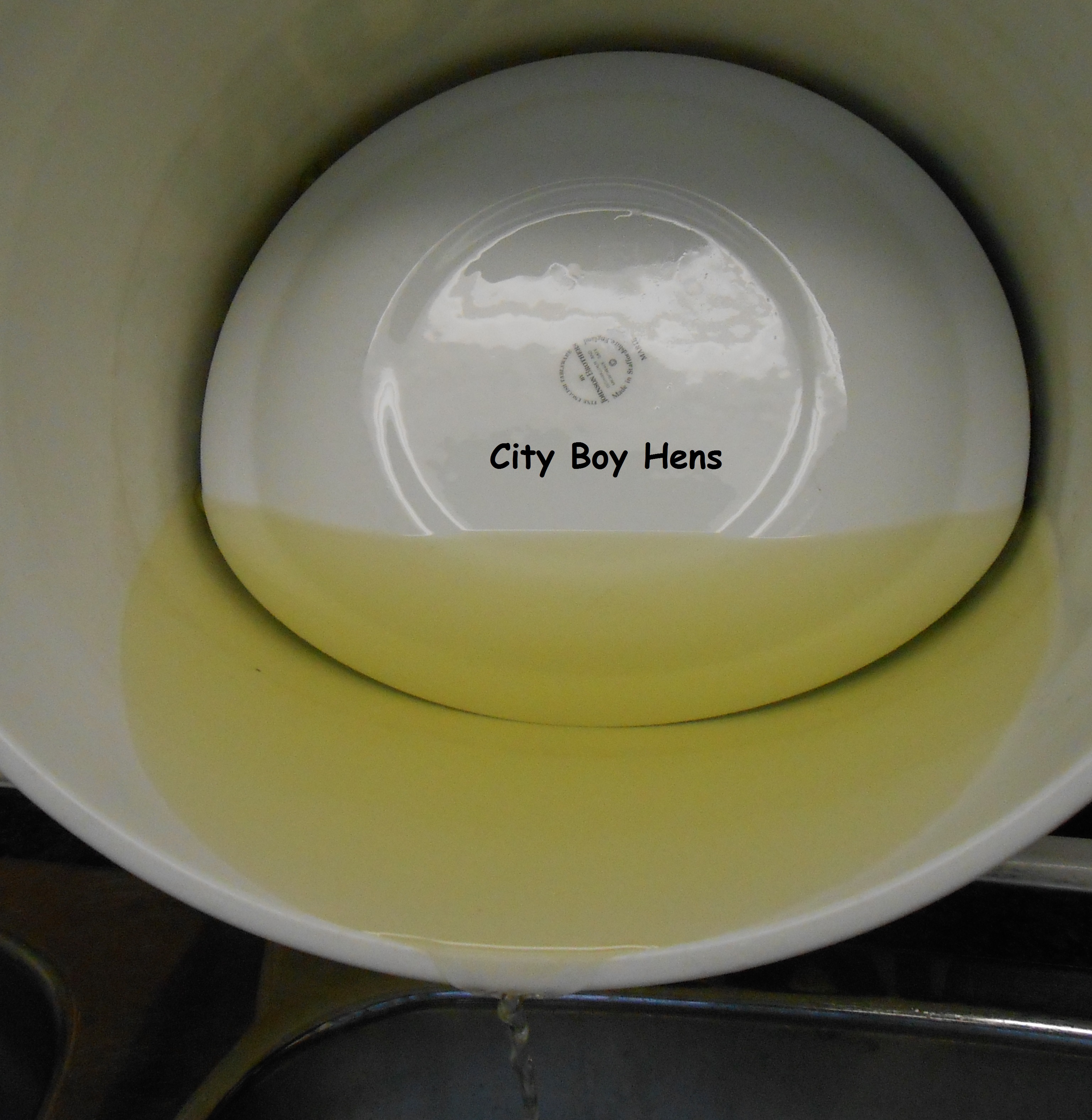
By day 2, the brine solution will begin to discolor.  Dump out the brine by tipping the bucket while firmly pushing down on the dinner plate.  Remove the plate and rinse the olives in the bucket.  Make up your brine solution and continue to repeat this process.

By around day 5, you will begin to hear large air bubbles occasionally escaping from under the plate.  This is a great sign that the olives are beginning to ferment.

Continue changing the brine ever other day until day 18.  Now taste an olive.  It should be firm and have a subtle salty olive rich taste.  If it still taste a bit bitter, give it another few days.

This is what the color of my brine solution looked like by day 16.  It is light green/yellow in color and had a rich aromatic scent.017

This is what my olives looked like by day 18.  Notice how the color is no longer bright green, but more of a…..well….olive drab color.  This is a good sign that you are almost ready to be preserve them in some mason jars.019

By day 18-21, the olives should be ready to be jarred.  Once again, it is not an exact science so you will have to rely on your taste buds.  If they no longer taste bitter or are only slightly bitter, than it is time to pack them in mason jars.  In order to extend their shelf life and ensure a safe edible product, it is necessary to increase the salt content in the brine to 1 cup of pickling salt for every 10 cups of water. I used 1 1/2 cups of pickling salt and 15 cups of water in order to make my brine.   I remember hearing about a traditional “old school” method that used an egg in order to achieve the proper salinity in a brine.  When the egg floated in the brine, the proper salinity was achieved!

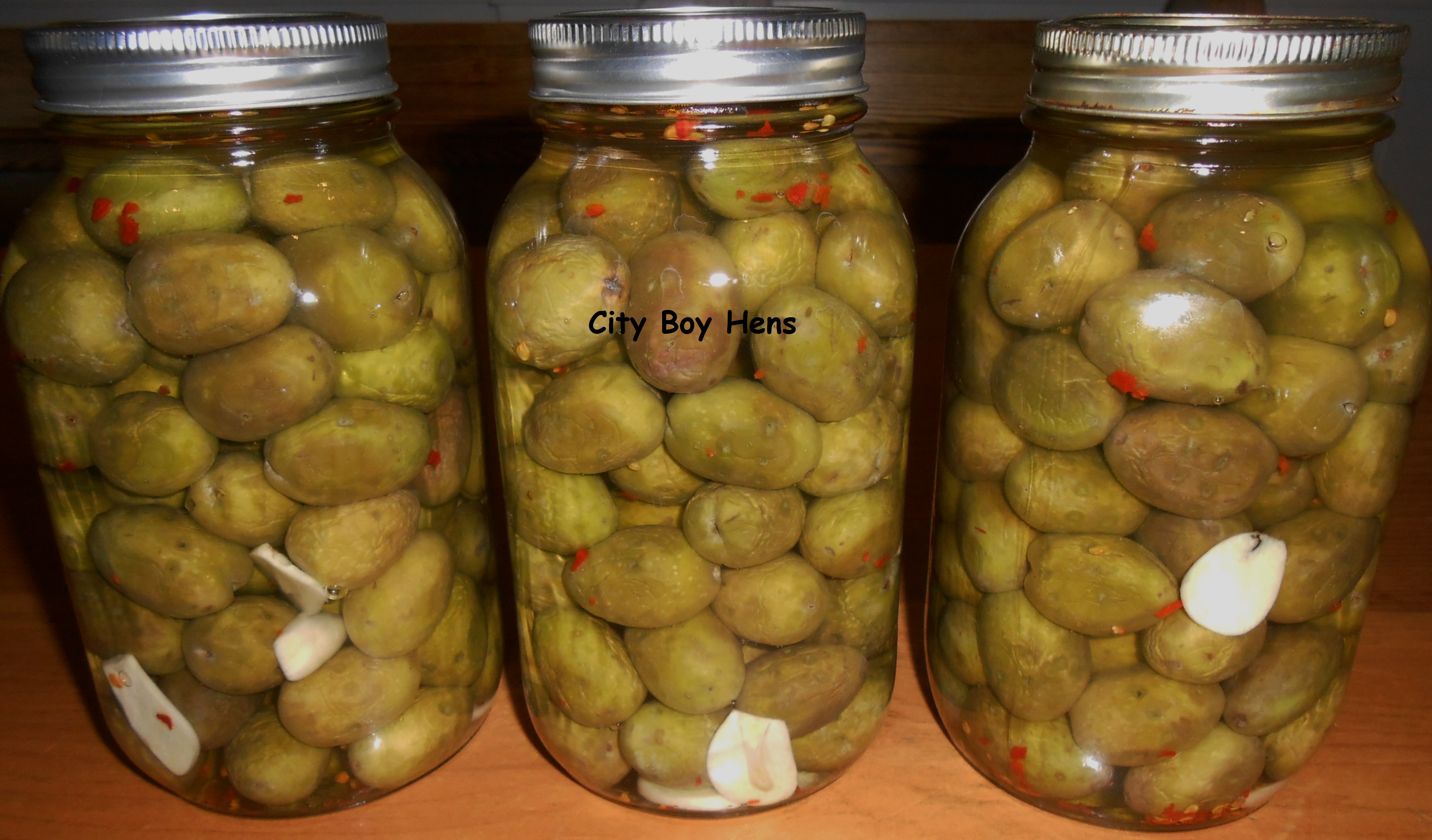
Now sterilize your jars in the oven at 225 degrees Fahrenheit  for 10 minutes. Place the canning rings and seals in a small pot of water and bring this to a simmer for 10 minutes as well.  Once the jars are sterilized, put 1/2 teaspoon of chill peppers and 1-2 cloves of sliced garlic in each quart jar.  Now pack the olives into the jars and pour the brine over the fruit until they are completely submerged.  *Note:  Some folks have recommended that the brine be heated and the sealed jars be boiled in a canner for 15 minutes.  I recommend that you follow the canning practices that make you feel secure.

012  Top up the jars with 1/4″ of olive oil.  This will create a barrier which will prevent the air at the top of the jar from possibly contaminating the olives.017  Now seal up the jars and store them in your cantina or cupboard for the next 12 months.019

Oh……..I almost forgot…..Keep your opened jar stored in the fridge and continue to top up with olive oil.  A spoonful of this flavored oil tastes amazing on your pasta dishes!  I hope you’ll give it a try.

My Cottage Garden BELLY FLOP!

As the Canadian Thanksgiving ends and the American Thanksgiving approaches, I thought it would be a “humbling” experience to chronicle the “results” of my cottage garden.  It all started back in the winter when I had the hair-brained idea to make a vegetable garden at the cottage.  The rational for making the cottage garden was two-fold.  First, we spend a lot of time at the cottage in the warmer months.  Secondly, I have nowhere at home to build a suitably sized garden.

So back in early May, a few of my high school buddies helped me build a raised bed garden at the cottage during one of our bi-annual weekends together. I went to great lengths & cost in order to make my garden predator proof and  I had a local guy deliver 4 yards of triple-mix.  Everything was going along well, even though Mr. Local Guy was quite concerned that I would be growing my pot too close to the road.  I assured him that it would be vegetables that I would “attempt” to grow.  He gave me the same look that most rural folks give when they hear that I take our chickens to the cottage.032I then proceeded to plant the garden in early June.

Tomatoes, Hot Peppers, Basil, Leeks and Bush Beans

Tomatoes, Hot Peppers, Basil, Leeks and Bush Beans

Throughout July I lovingly tended my gardens.  I watered, weeded and sent silent thoughts of encouragement for a bountiful harvest to begin in August.  Maybe my thoughts weren’t encouraging enough because my garden didn’t respond with a yield that could feed one, let alone a family of 4.  By late August,  I knew we were in trouble with a harvest of only 7 beans, 3 cherry tomatoes and a miniscule feed of Swiss chard that wouldn’t even provide a snack for the chickens, let alone a side dish for this City Boy.  By Labor Day, I knew we were doomed.  It pained me to watch many of you write posts on your successful gardens and all of the produce that you would consume and share.  Don’t get me wrong….I was happy for each of you.  I just wanted a bit of tasty success for my own family.024As it turns out, Jack Frost dealt his deadly blow before the Canadian Thanksgiving.  So much for the dream of plump red Roma tomatoes that were destined to be bruschetta, salad accompaniments, and sandwich fillers.   As for the Leeks…..they were suppose to be the main ingredient in our Leek & Potato soupChili peppers…….they were to be dried, crushed and used in our hot Italian sausage and salami making recipes I could go on and on, but it hurts too damn much!

In hind-sight, I now see that my fatal mistake came way back in May long before I even planted my garden.  I still remember that fateful Saturday when my two buddies and I thoroughly discussed the location of the garden while quenching our thirst on a few beers from a local micro-brewery.  Maybe there was some mind altering ingredient in that micro-brewery beer?   Maybe it was the heat of the sun that beat down on our Vitamin E deprived brows?      But…….maybe………….. it was the fact that the  FREAKIN’ LEAVES ON THE ENORMOUSLY LARGE FREAKIN’ TREES THAT GREW FAR ENOUGH AWAY FROM THE GARDEN WERE STILL IN THEIR TINY  FREAKIN’ BUDS……..BUDS THAT WERE WAITING TO OPEN AND BLOCK ANY POSSIBILITY OF SUNLIGHT AFTER 3PM!  Damn!  How could I have been so stupid?  Nonno, If you are looking down on me….please stop shaking your head.  I know I came from a family that had its roots in farming, but I’m just a City Boy trying to reconnect with his Family’s past.

Well….I might as well get it over with….swim out to the raft….proceed to jump off and make the biggest belly flop that I am capable of making……………….019But wait………..Why should I be the only one punished for this oversight???????   Ah Hello??????  Mr. 5 Maples……..don’t you guys hold any responsibility for taking away my mid-afternoon sun which created that 2 inch cucumber, those emaciated leeks and the green tomatoes that refuse to turn red??????   025DAMN STRAIGHT YOU DO!  Well………at least it’s gonna’ be warm in the cottage next WINTER!     “Hey Beloved Wife……did you happen to get any leeks at the grocery store today?  I’m thinking about making some soup for dinner tonight!031

My Honey Bee Queen is………. DEAD!

014I should have heard them screaming that the Queen was Dead.  I should have seen that the flag was at half mast beside the hive.  I should have been there as the funeral procession  exited the hive and their little bee heads hung in grief when they carried their beloved Queen to her final resting place.  I should have noticed, but…………… I wasn’t there.  Maybe I was back at home in the City.  Maybe I was up at the cottage sitting on the dock sipping beer from a local micro-brewery.  Either way, it didn’t matter.  I wasn’t at the hive.  Not that I really could have done much. It’s not like I could have saved her.   I don’t even know why she died or how she died……….  I just know she’s………. dead……(A momentary  pause for dramatic effect!)

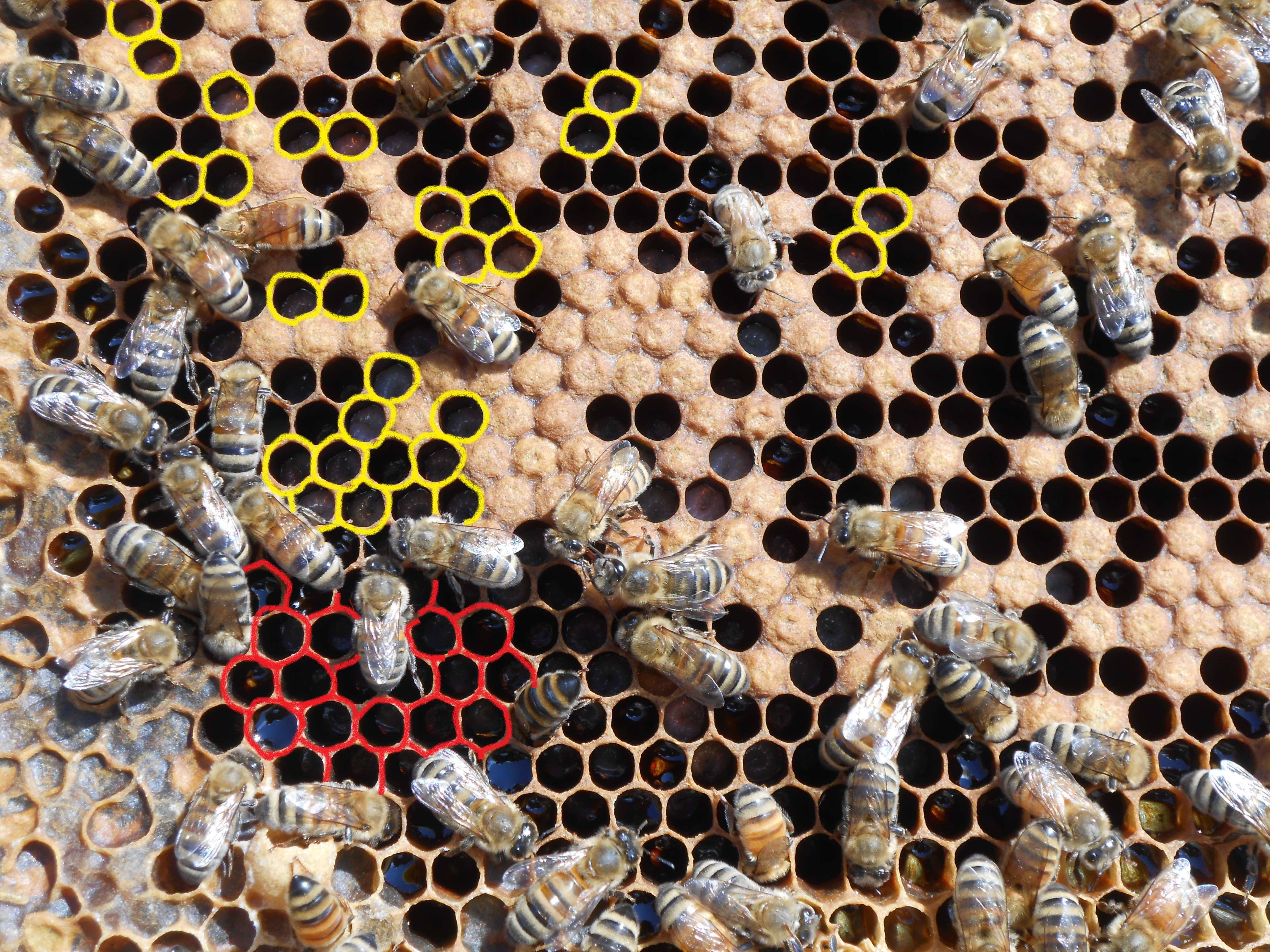
So….maybe you’re asking yourself how I knew for certain that the hive was queenless?  I knew I was in trouble yesterday afternoon as soon as I took the first frame out of the hive.  There was no brood to be found anywhere in the comb.  There were plenty of bees, lots of pollen and even some honey, but no brood to be found.  Considering that a Queen can lay upwards of 1000 eggs each day, you’d think that I’d find some brood tucked away in that comb. Take a look at the picture below.  It is from my hive in July.  If you look carefully at the yellow circled frames, you will see brood tucked into the comb.  They look like fat white grubs.

Drawn out comb filled with nectar or brood.

Drawn out comb filled with nectar or brood.

Anyways, I continued to inspect each frame with the same dismal results.  Zilch, Nadda, Niente!  I couldn’t believe my luck.  First, I couldn’t get a mated Queen until early July because there was such a shortage this year in Northern Ontario.  Now, she up and died, leaving thousands of bees without a Queen.  But worst of all, Fall has begun and the hive Will Not survive without a Queen to produce the Winter Bees who will carry the hive through the  cold months ahead.    So…..if I don’t do something soon, I’ll be starting again from square one next Spring.   But, it isn’t not only for me that I must find a solution…….it is also for the remaining bees that will need my help.

It turns out that one of Dan’s hives (my mentor) has been suffering this year and it is having trouble building up to a strong colony.  It too, would not survive the harsh Northern Ontaio Winter.  After sitting down in the apiary together and discussing our individual delemas, we decided to combine our hives in order to make one strong hive that still had time to learn to get along and become one happy colony.  After taking a quick look through Bee Keeping For Dummies, we confirmed our plan of attack and thus was born our attempt at the newspaper method.

According to Howland Blackiston “ you can’t just dump the bees from one hive into another. If you do, all hell will break loose. Two colonies must be combined slowly and systematically so that the hive odors merge gradually. This is best done late in the summer or early in the autumn”.

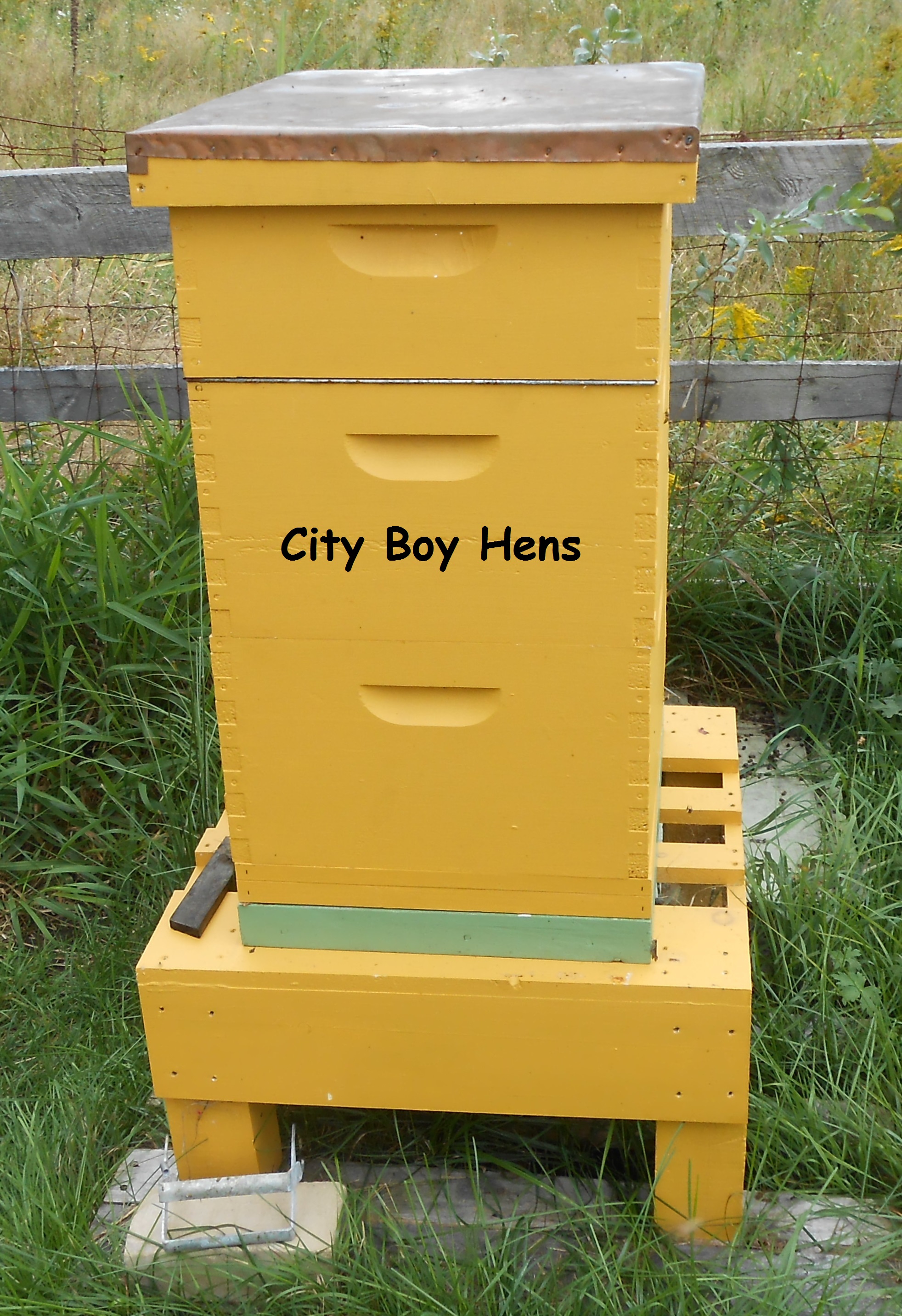
Well……I guess are timing was good because we got the early autumn part right.  Now, we just had to move my hive into Dan’s weaker, but Queen maintained, hive.  So I took the cover off of my hive and began shaking  the bees off of the honey bee frames that were in the top hive body (the upper box).  In doing so, my bees would drop down into the lower hive body which was the one that would be placed on Dan’s hive..  Believe it or not, we did this process without even using the smoker to help keep the bees calm.

Next, the hive cover was taken off of Dan’s hive and a single sheet of newspaper was placed on top of his top hive body.  I then cut a few slits in the newspaper which would act as the innitial passageway between the 2 hives.  In doing so,the hive odors from each hive would  “slowly and systematically” begin to merge together.033

Once this was done, the hive cover was then placed on top of the new combined hive.

According to Blackiston, , the bees should chew through the newspaper in about a week and Dan & I should have a ” happily joined into one whacking strong colony”.

Well……“whacking strong” seems pretty impressive from where I stand.  I’ll shoot for strong and hope for the best.  “Hey Dan………..what part of the newspaper did we put on the hive?   I hope it was something interesting because them there bees are gonna’ be doing some recreational reading for the next 7 days.  I just hope it wasn’t the obituary section”036